There is a strange expectation in the modern world:
If people want more of something, simply make more of it.
More production.
More inventory.
More machines.
More speed.
That logic works for manufactured products.
It does not define how we believe real Himalayan Shilajit should be treated.
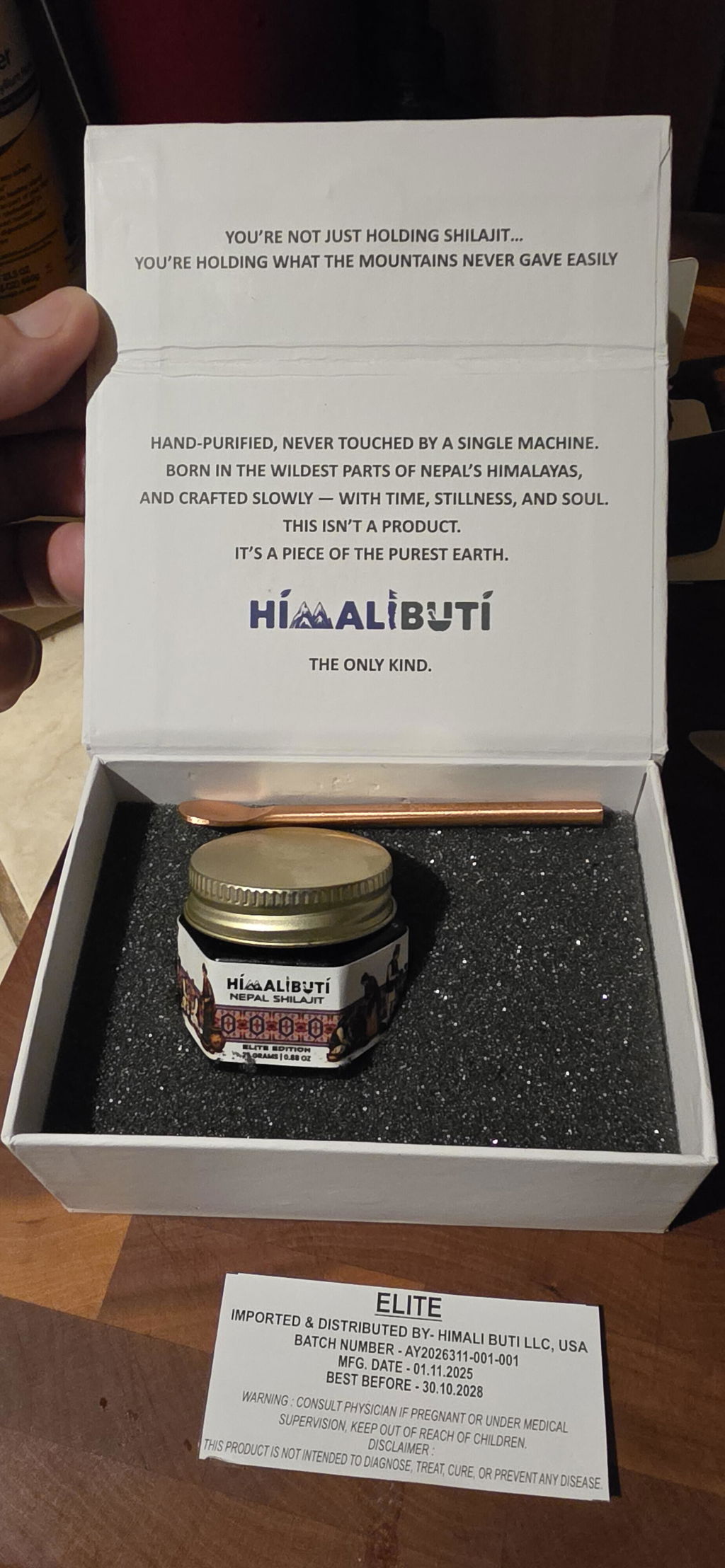
The jar in this photograph represents the opposite idea.
Not unlimited production.
Not a factory trying to keep shelves permanently full.
But a natural material whose journey begins far away from the shelf, in the mountains of Nepal.
BEFORE THERE IS A JAR, THERE IS A MOUNTAIN
Most people encounter Shilajit only after everything difficult has already happened.
They see a dark resin.
A jar.
A box.
A brand name.
But the finished product is only the final chapter.
For Himalibuti, the story begins with Himalayan stone sourced from Upper Dolpa, Nepal.
Before that material can become the resin inside this jar, it must pass through collection, careful purification and patient human work.
That distinction matters.
Because Shilajit should not become “premium” when the packaging is designed.
Its value should already exist before the packaging ever touches it.
WHY NOT SIMPLY MAKE MORE?
Because our goal is not to make the largest possible quantity.
Our goal is to remain faithful to the source and process we chose.
Natural material is not an industrial formula.
Human work has limits.
Time has limits.
And when you refuse to replace those limits with shortcuts simply to increase output, production cannot behave like an endless factory line.
For many businesses, limitation is a problem to solve.
For us, some limitations are worth protecting.
HANDMADE IS NOT A DESIGN WORD
“Handmade” is easy to print.
It is much harder to build a process around.
When human hands remain part of the journey, scale becomes more difficult.
It takes longer.
It demands attention.
It refuses some of the efficiencies that modern manufacturing expects.
That is precisely why the words matter to us.
No machine as the shortcut.
No factory-style mass-production philosophy.
Only human hands carrying the material through a process we believe should remain connected to its Himalayan origin.
THE BOX SHOULD NEVER BE MORE IMPORTANT THAN WHAT IS INSIDE IT
We care deeply about how Himalibuti looks.
But beautiful packaging cannot create real Shilajit.
A premium photograph cannot improve poor sourcing.
A luxury box cannot replace careful purification.
And a powerful advertisement cannot change what happened before the jar was filled.
So when judging Shilajit, look beyond the front of the box.
Ask where it came from.
Ask how it became resin.
Ask whether the brand can explain its process.
Ask what was done before anyone started thinking about packaging.
Because that is where the real difference begins.
WHY “NOT EVERYONE WILL GET THIS JAR”
This statement is not about excluding people.
It is about refusing an idea:
That every natural product must become endlessly scalable simply because demand exists.
If maintaining a particular source and a human-led process means there are limits to what can be made, then we would rather accept those limits than redesign the product around volume.
We would rather make what we believe in than make enough for everyone.
That is the point.
FROM UPPER DOLPA TO THE PERSON HOLDING THE JAR
There is an enormous distance between Himalayan stone and the finished jar sitting quietly on a table.
Geographically, yes.
But more importantly, in human effort.
The source has to be reached.
The material has to be collected.
The transformation from rock-associated raw material to finished resin has to happen.
The resin has to be handled, filled and prepared.
Only then does it become the small jar someone eventually opens at home.
When you understand that journey, the jar looks different.
It is no longer simply 25 grams of dark resin.
It represents everything that had to happen for those 25 grams to exist in that form.
THE REAL MEANING OF PREMIUM
Premium should not mean making an ordinary product look expensive.
For Himalibuti, premium begins where the customer cannot see.
At the source.
In the process.
In the time we refuse to remove.
In the human work we refuse to replace simply for greater volume.
The packaging comes afterward.
That is why this jar does not need to belong to everyone.
It needs to remain true to what it is.
HIMALIBUTI
Nepal Shilajit.
From Upper Dolpa.
Rock to resin.
Made with human hands.
Not everyone will get this jar.
And that’s the point.